Home » Technology » Asus TUF GAMING B850-BTF Review
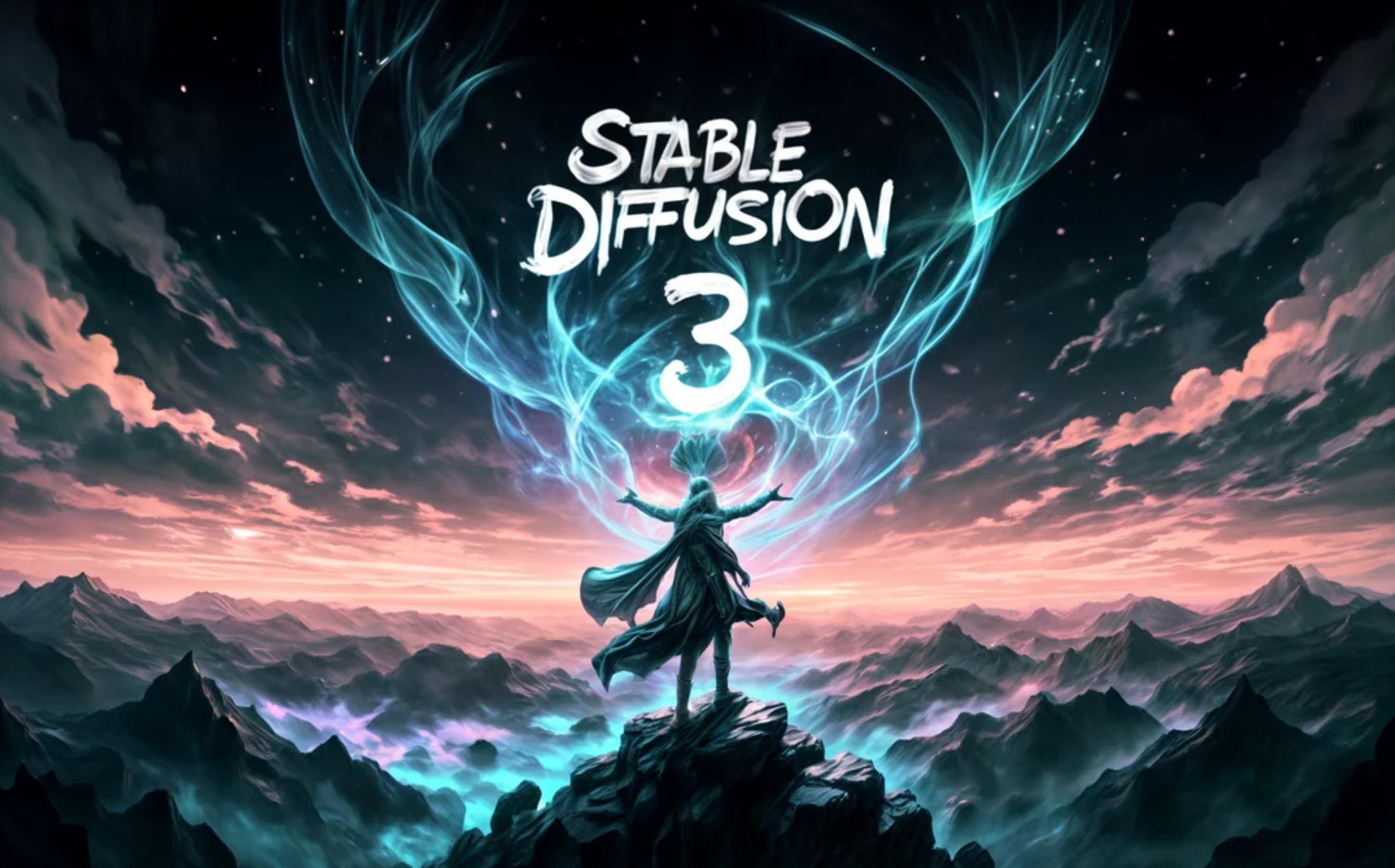
Stability AI has introduced Stable Diffusion 3, a next-generation image generation model designed to create even more detailed and multi-object visuals based on text prompts. The new system builds on previous releases, delivering improved quality, accuracy, and text-to-image synthesis capabilities.
According to the company, the Stable Diffusion 3 model family ranges from 800 million to 8 billion parameters, accepting text descriptions (prompts) and transforming them into high-quality images. This wide scale allows different model versions to run on various hardware — from smartphones to high-performance servers. The number of parameters directly influences image detail, with larger models requiring more VRAM on GPUs to perform at full capacity.
Stability has been developing advanced image synthesis models since 2022, releasing Stable Diffusion 1.4, 1.5, 2.0, 2.1, XL, XL Turbo, and now version 3. The company positions itself as an open alternative to proprietary systems like OpenAI’s DALL-E 3, although discussions continue regarding copyright-protected training data, potential biases, and risks of misuse. A key advantage of Stable Diffusion is that models can be fine-tuned locally for personalized results.
CEO Emad Mostaque explains that Stability AI is using a new diffusion-transformer architecture similar to Sora, enhanced with flow matching and further optimization layers. These upgrades improve scalability and allow the system to operate with multimodal input.
Stable Diffusion 3 leverages flow matching, a technique where AI gradually converts random noise into a structured final image — without needing to simulate each individual diffusion step. Instead, it forms an overall directional flow, producing images more efficiently and coherently.
For now, Stable Diffusion 3 remains in closed testing. Once development concludes, the model is expected to be available for free download and local use.